
ghost模型的效果
GhostNet是为移动设备设计的,文中没有给出在GPU端的开销情况,在华为P30 Pro上进行了GhostNet的实际推理速度测试,并和其他模型进行了对比,所以在GPU上的实际效果还需要测试。和MobileNetV3相比,相同FLOPs的情况下,大约可以提升0.3%~0.5%不等的top-1准确率,相同Latency的情况下,大约可以提升0.5%的top1准确率。在Top1准确率在75%的情况下,GhostNet的Latency大约是40ms,而MobileNetV3大约是45ms。得出结论认为GhostNet总体好于当前的MobileNetV3,MobileNetV2,EfficientNet,ShuffleNetV2,MnasNet,FBNet,ProxylessNAS等网络。【0】


ghost模型实现原理

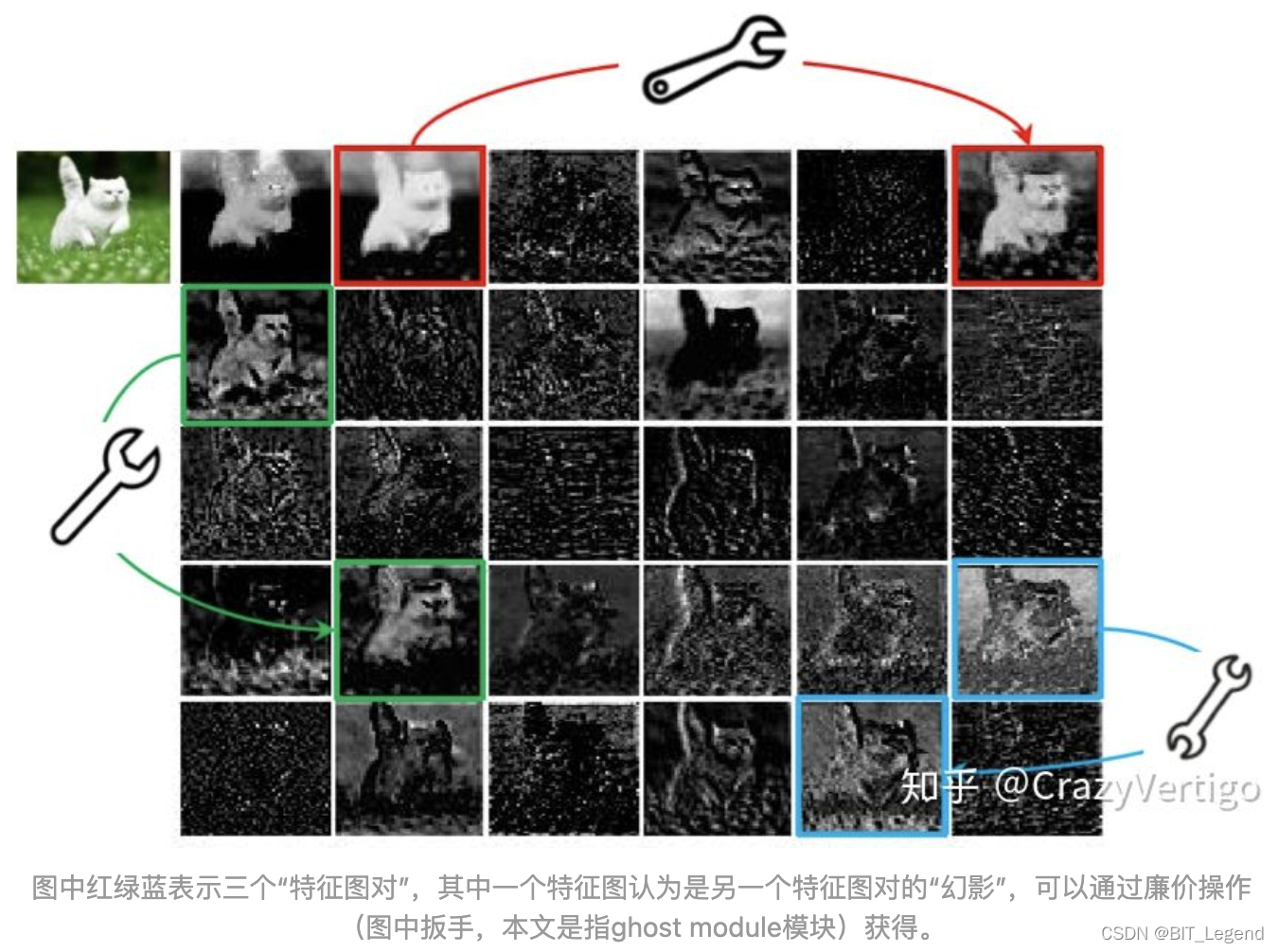
ghost模型的整个结构照搬了mobilenetv3,只是把基本单元给替换掉了,ghost模型的基本单元如上图所示,将原本的一步卷积变为两步卷积,第一步首先进行常规卷积,但是减少了输出通道数,第二步在第一步的基础上进行深度可分离卷积(仅取第一步),这里深度可分离卷积跟常规深度可分离卷积有点区别,常规深度可分离卷积(仅取第一步)的输入输出通道数完全相等,卷积核数量也等于输入通道数,这里输出通道数可能是输入通道数的整数倍,卷积核数量等于输出通道数。此外,第二步卷积还有并行的一个连接分支,这个分支直接就是第一步卷积的输出。ghost卷积模块的输出通道数等于第一步卷积后的通道数c加上第二步卷积后的通道数n*c,所以最终通道数为(n+1)*c。此操作的依据是经过观察,发现大部分卷积操作后,输出的特征图很多通道之间存在很高的相似性,那我们就可以经过第一步卷积得到那些没有相似性的通道,然后经过第二步卷积得到剩余那些有相似性的通道,可视化如下图:
ghost模型实现代码
ghost模型由华为提出,在github上有官方的torch和tensorflow代码,以下为官方torch代码。
# 官方代码的ghost网络模型 https://github.com/huawei-noah/CV-Backbones
"""
Creates a GhostNet Model as defined in:
GhostNet: More Features from Cheap Operations By Kai Han, Yunhe Wang, Qi Tian, Jianyuan Guo, Chunjing Xu, Chang Xu.
https://arxiv.org/abs/1911.11907
Modified from https://github.com/d-li14/mobilenetv3.pytorch and https://github.com/rwightman/pytorch-image-models
"""
import torch
import torch.nn as nn
import torch.nn.functional as F
import math__all__ = ['ghost_net']# 设定整个模型的所有BN层的衰减系数,该系数用于平滑统计的均值和方差,torch与tf不太一样,两者以1为互补
momentum = 0.01  # 官方默认0.1,越小,最终的统计均值和方差越接近于整体均值和方差,前提是batchsize足够大# 保证v可以被divisor整除
def _make_divisible(v, divisor, min_value=None):if min_value is None:min_value = divisornew_v = max(min_value, int(v + divisor / 2) // divisor * divisor)if new_v < 0.9 * v:new_v += divisorreturn new_v# 定义激活函数
def hard_sigmoid(x, inplace: bool = False):if inplace:return x.add_(3.).clamp_(0., 6.).div_(6.)else:return F.relu6(x + 3.) / 6.# 定义SE模块
class SqueezeExcite(nn.Module):def __init__(self, in_chs, se_ratio=0.25, reduced_base_chs=None, act_layer=nn.ReLU, gate_fn=hard_sigmoid, divisor=4, **_):super(SqueezeExcite, self).__init__()self.gate_fn = gate_fnreduced_chs = _make_divisible((reduced_base_chs or in_chs) * se_ratio, divisor)self.avg_pool = nn.AdaptiveAvgPool2d(1)self.conv_reduce = nn.Conv2d(in_chs, reduced_chs, 1, bias=True)self.act1 = act_layer(inplace=True)self.conv_expand = nn.Conv2d(reduced_chs, in_chs, 1, bias=True)def forward(self, x):x_se = self.avg_pool(x)x_se = self.conv_reduce(x_se)x_se = self.act1(x_se)x_se = self.conv_expand(x_se)x = x * self.gate_fn(x_se)return x    # 定义基本卷积模块
class ConvBnAct(nn.Module):def __init__(self, in_chs, out_chs, kernel_size, stride=1, act_layer=nn.ReLU):super(ConvBnAct, self).__init__()self.conv = nn.Conv2d(in_chs, out_chs, kernel_size, stride, kernel_size//2, bias=False)self.bn1 = nn.BatchNorm2d(out_chs, momentum=momentum)self.act1 = act_layer(inplace=True)def forward(self, x):x = self.conv(x)x = self.bn1(x)x = self.act1(x)return x# 定义ghost模块
class GhostModule(nn.Module):def __init__(self, inp, oup, kernel_size=1, ratio=2, dw_size=3, stride=1, relu=True):super(GhostModule, self).__init__()self.oup = oupinit_channels = math.ceil(oup / ratio)new_channels = init_channels*(ratio-1)self.primary_conv = nn.Sequential(nn.Conv2d(inp, init_channels, kernel_size, stride, kernel_size//2, bias=False),nn.BatchNorm2d(init_channels, momentum=momentum),nn.ReLU(inplace=True) if relu else nn.Sequential(),)self.cheap_operation = nn.Sequential(nn.Conv2d(init_channels, new_channels, dw_size, 1, dw_size//2, groups=init_channels, bias=False),nn.BatchNorm2d(new_channels, momentum=momentum),nn.ReLU(inplace=True) if relu else nn.Sequential(),)def forward(self, x):x1 = self.primary_conv(x)x2 = self.cheap_operation(x1)out = torch.cat([x1,x2], dim=1)return out[:,:self.oup,:,:]# 定义ghost网络基本单元
class GhostBottleneck(nn.Module):""" Ghost bottleneck w/ optional SE"""def __init__(self, in_chs, mid_chs, out_chs, dw_kernel_size=3,stride=1, act_layer=nn.ReLU, se_ratio=0.):super(GhostBottleneck, self).__init__()has_se = se_ratio is not None and se_ratio > 0.self.stride = stride# Point-wise expansionself.ghost1 = GhostModule(in_chs, mid_chs, relu=True)# Depth-wise convolutionif self.stride > 1:self.conv_dw = nn.Conv2d(mid_chs, mid_chs, dw_kernel_size, stride=stride,padding=(dw_kernel_size-1)//2,groups=mid_chs, bias=False)self.bn_dw = nn.BatchNorm2d(mid_chs, momentum=momentum)# Squeeze-and-excitationif has_se:self.se = SqueezeExcite(mid_chs, se_ratio=se_ratio)else:self.se = None# Point-wise linear projectionself.ghost2 = GhostModule(mid_chs, out_chs, relu=False)# shortcutif (in_chs == out_chs and self.stride == 1):self.shortcut = nn.Sequential()else:self.shortcut = nn.Sequential(nn.Conv2d(in_chs, in_chs, dw_kernel_size, stride=stride,padding=(dw_kernel_size-1)//2, groups=in_chs, bias=False),nn.BatchNorm2d(in_chs, momentum=momentum),nn.Conv2d(in_chs, out_chs, 1, stride=1, padding=0, bias=False),nn.BatchNorm2d(out_chs, momentum=momentum),)def forward(self, x):residual = x# 1st ghost bottleneckx = self.ghost1(x)# Depth-wise convolutionif self.stride > 1:x = self.conv_dw(x)x = self.bn_dw(x)# Squeeze-and-excitationif self.se is not None:x = self.se(x)# 2nd ghost bottleneckx = self.ghost2(x)x += self.shortcut(residual)return x# 搭建ghost网络模型,整个网络模型完全照搬mobilenetv3,仅仅只是更换了网络基本单元
class GhostNet(nn.Module):def __init__(self, cfgs, num_classes=1000, width=1.0, dropout=0.2):super(GhostNet, self).__init__()# setting of inverted residual blocksself.cfgs = cfgsself.dropout = dropout# building first layeroutput_channel = _make_divisible(16 * width, 4)self.conv_stem = nn.Conv2d(3, output_channel, 3, 2, 1, bias=False)self.bn1 = nn.BatchNorm2d(output_channel, momentum=momentum)self.act1 = nn.ReLU(inplace=True)input_channel = output_channel# building inverted residual blocksstages = []block = GhostBottleneckfor cfg in self.cfgs:layers = []for k, exp_size, c, se_ratio, s in cfg:output_channel = _make_divisible(c * width, 4)hidden_channel = _make_divisible(exp_size * width, 4)layers.append(block(input_channel, hidden_channel, output_channel, k, s,se_ratio=se_ratio))input_channel = output_channelstages.append(nn.Sequential(*layers))output_channel = _make_divisible(exp_size * width, 4)stages.append(nn.Sequential(ConvBnAct(input_channel, output_channel, 1)))input_channel = output_channelself.blocks = nn.Sequential(*stages)        # building last several layersoutput_channel = 1280self.global_pool = nn.AdaptiveAvgPool2d((1, 1))self.conv_head = nn.Conv2d(input_channel, output_channel, 1, 1, 0, bias=True)self.act2 = nn.ReLU(inplace=True)self.classifier = nn.Linear(output_channel, num_classes)def forward(self, x):x = self.conv_stem(x)x = self.bn1(x)x = self.act1(x)x = self.blocks(x)x = self.global_pool(x)x = self.conv_head(x)x = self.act2(x)x = x.view(x.size(0), -1)if self.dropout > 0.:x = F.dropout(x, p=self.dropout, training=self.training)x = self.classifier(x)    # 最后的输出层并不包含激活函数,直接就是全链接的输出,在损失函数中包含softmax操作,实际使用需要自己再加一个softmaxreturn xdef ghostnet(**kwargs):"""Constructs a GhostNet model"""cfgs = [# k, t, c, SE, s # stage1[[3,  16,  16, 0, 1]],# stage2[[3,  48,  24, 0, 2]],[[3,  72,  24, 0, 1]],# stage3[[5,  72,  40, 0.25, 2]],[[5, 120,  40, 0.25, 1]],# stage4[[3, 240,  80, 0, 2]],[[3, 200,  80, 0, 1],[3, 184,  80, 0, 1],[3, 184,  80, 0, 1],[3, 480, 112, 0.25, 1],[3, 672, 112, 0.25, 1]],# stage5[[5, 672, 160, 0.25, 2]],[[5, 960, 160, 0, 1],[5, 960, 160, 0.25, 1],[5, 960, 160, 0, 1],[5, 960, 160, 0.25, 1]]]return GhostNet(cfgs, **kwargs)if __name__=='__main__':model = ghostnet()model.eval()print(model)input = torch.randn(32,3,320,256)y = model(input)print(y.size())
包含训练和测试的完整代码见:https://github.com/LegendBIT/torch-classification-model
参考
0. GhostNet学习笔记